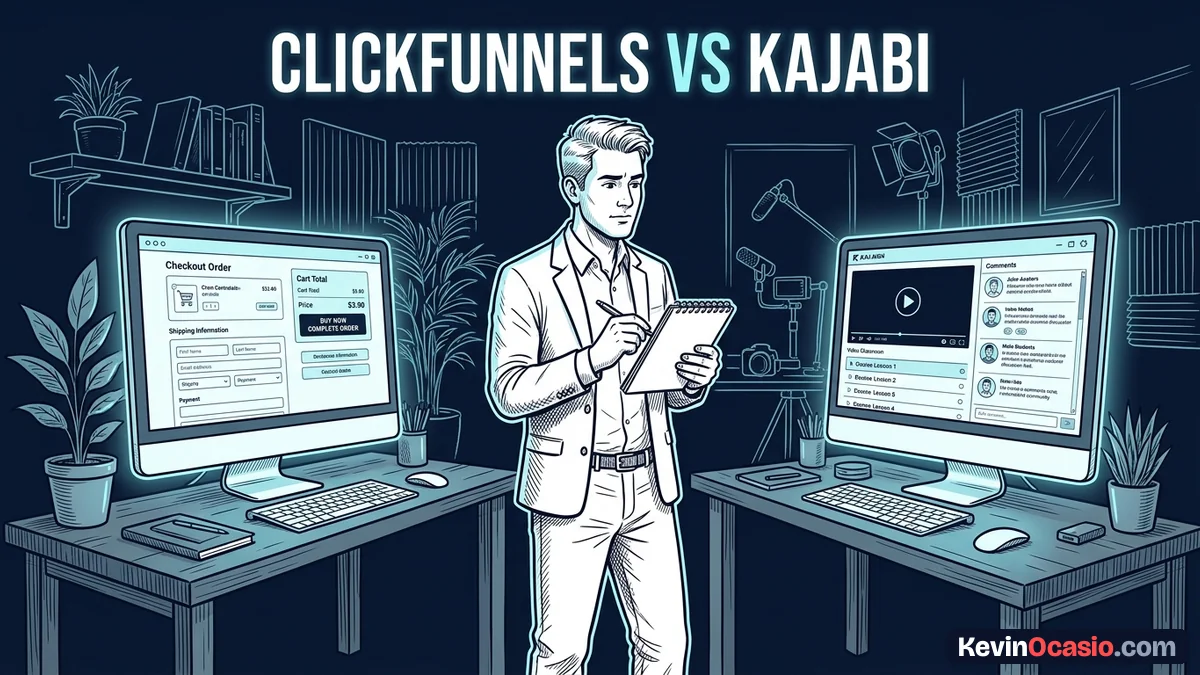
Comparing ClickFunnels vs Kajabi comes down to one clear choice. You either sell hard at checkout, or you focus on student retention. One tool focuses on quick bumps and upsells. The other tool gives students a calm mobile campus to study and connect.
The Short Version
- ClickFunnels wins on sales funnels by giving you high-converting order bumps, one-click upsells, and split-testing tools built to lift your average order value.
- Kajabi wins on student experience through polished course delivery, native community forums, coaching pipelines, and a free mobile app for your students.
- Pick based on your offer so you only pay for the checkout tools or student features your business model needs to make a profit.
Jump to Section
- ClickFunnels vs Kajabi: Direct-Response Funnels or Student Retention?
- The Course Experience: Mobile Student Apps vs Basic Member Portals
- Pricing Math and Feature Caps: Comparing the Real Monthly Cost
- Pick the Platform That Fits Your Real Business Model
- Frequently Asked Questions About ClickFunnels vs Kajabi
ClickFunnels vs Kajabi: Direct-Response Funnels or Student Retention?
You choose ClickFunnels for one specific job. ClickFunnels exists to make sales the moment a buyer pulls out a card. Russell Brunson built it around direct-response marketing rules. Every click on the page must pull its own weight.
When a buyer lands on your checkout page, ClickFunnels works hard to raise your cart total. You can add a quick order bump right above the payment box with one click. Once the buyer pays, ClickFunnels shows an instant upsell. That happens before the buyer sees a thank-you page.
Running paid ads to cheap digital items takes real sales power. When you run your checkout through ClickFunnels, turning a thirty-dollar buyer into an eighty-dollar order changes your math. It lets you outspend rivals on ad clicks. You still walk away with a profit.
Kajabi views the sales process from another angle. It treats your checkout as a simple front door to a private club. The checkout forms look clean, but you won’t find deep upsell flows or split-testing tools here. It’s not built for aggressive sales funnels.
That design makes Kajabi a poor match for quick sales tricks. Kajabi puts its focus on what happens after the payment clears. If you try to run complex funnel paths inside Kajabi, you hit a wall. But if you want a clean coaching space, Kajabi gives off a clear feeling of high quality.
The Course Experience: Mobile Student Apps vs Basic Member Portals
The biggest split between these two tools starts after the sale. ClickFunnels 2.0 has a course builder. It works like a basic digital file locker. Students log in on a web browser to see their lessons and grab files.
A simple video list works fine for a short workshop or a PDF. But if you sell a deep training program, a plain file locker rarely keeps students engaged. People watch a lesson or two. They get busy, and they stop logging in.
Kajabi delivers training through a dedicated mobile app on iOS and Android. Every student gets access to the official Kajabi app at no added cost to you. Students can stream your lessons on the go. They can listen to audio files in the car, or finish tasks on their phone.
Beyond mobile video, Kajabi gives you active community boards. Students can join discussion threads and send direct messages. They can also track their course progress. Keeping student engagement high in online courses takes peer interaction, which stops members from quitting after month one.
Building a steady monthly membership calls for those community tools. On the other hand, you might just want to deliver video lessons without high monthly fees. In that case, you can easily sell an online course on a budget using simple tools that cost much less.
Pricing Math and Feature Caps: Comparing the Real Monthly Cost
Take a close look at the monthly pricing and usage caps before you buy.
| Plan Feature | ClickFunnels Launch ($97/mo) | Kajabi Basic ($179/mo) |
|---|---|---|
| Annual Billing Rate | $81/mo ($972 billed yearly) | $143/mo ($1,716 billed yearly) |
| Course Product Limit | Unlimited courses | Strict limit of 3 products |
| Sales Funnel Limit | 20 sales funnels | Strict limit of 3 funnels |
| Contact Capacity | 10,000 contacts | 2,500 active contacts |
| Native Mobile Student App | No native student app | Included for iOS and Android |
| Transaction Fees | 0% platform fees | 0% platform fees |
The pricing grid shows a big gap in how both tools cap your account. Kajabi charges $179 a month, or $143 monthly when paid on an annual term. Yet that tier locks you to a strict limit of just three products and three funnels. You also get only 2,500 active contacts.
Adding two courses, a quick workshop, and a template will push you past that cap. To unlock your fourth product, Kajabi forces you up to the Growth plan at $249 a month ($199 when paid yearly). That means you must pay $2,388 to $2,988 each year just to host a small handful of digital downloads.
ClickFunnels Launch costs $97 monthly, which drops to $81 when paid for the full year ($972 total). For that lower price, ClickFunnels gives you unlimited courses, unlimited pages, twenty funnels, and up to 10,000 contacts. You have plenty of room to test new product ideas without being forced into an expensive upgrade.
Make sure you stop paying for software you don’t need until sales cover the cost. Spending $179 to $249 every month on Kajabi without paying students will drain your cash reserves long before you turn a profit.
Pick the Platform That Fits Your Real Business Model
Your decision comes down to how your business creates profit.
Choose ClickFunnels if you sell digital downloads, run paid ads, or rely on order bumps and upsells. It gives you the direct-response tools you need to turn visitors into buyers. Its $97 starter plan lets you host unlimited courses without punishing product caps.
Kajabi makes sense if your brand runs on a flagship coaching group, a mastermind, or a paid membership. The native mobile app and interactive student spaces create a polished learning home that keeps members paying month after month.
Focus on the offer you plan to launch this month. Pick the software that delivers the exact tools you need to make sales this week. Launch your offer, and protect your working cash.
Frequently Asked Questions About ClickFunnels vs Kajabi
Can you host and sell online courses inside ClickFunnels?
Yes, ClickFunnels 2.0 has a built-in course space to host video lessons, organize modules, and deliver files. It lacks Kajabi’s native mobile student app and deep social tools. But it handles standard video lesson delivery well.
Does Kajabi offer good checkout funnels with upsells?
Kajabi lets you add basic order bumps and post-purchase offers. But its sales funnels have tight limits. You can’t build complex branching upsell paths, and the checkout templates offer fewer options for split testing.
Which platform is easier to set up for a beginner?
For new creators, Kajabi is often easier to use because the dashboard focuses on content and student progress. ClickFunnels has a steeper learning curve because it gives you granular control over checkout steps, page designs, and automation flows.
Do I need separate email marketing software with either tool?
Neither platform requires an outside autoresponder for standard marketing. Kajabi includes unlimited marketing emails on its Basic tier. ClickFunnels Launch gives you up to 10,000 email contacts with full automations.
Which tool works better for running paid ads?
ClickFunnels holds a big edge when you run paid ads on networks like Meta or Google. Fast split-testing pages, checkout order bumps, and one-click upsells help you lift your average order value. That helps your ad spend turn a profit faster.
Can I connect my own custom domain to both platforms?
Both tools let you connect a custom web domain using standard DNS records. ClickFunnels Launch includes one custom domain. Kajabi Basic also lets you connect one domain name.