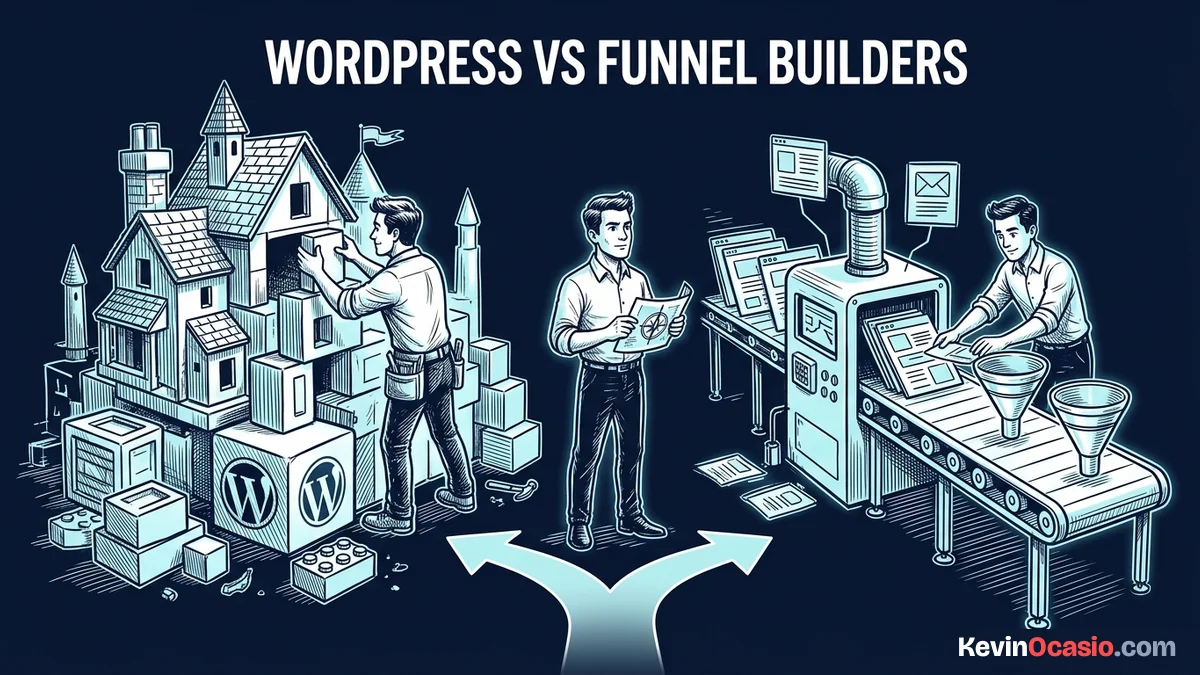
Choosing where to build your business comes down to the debate over WordPress vs funnel builders. One path gives you full control of every file you make. The other trades that control for fast sales funnels you can launch today.
The Short Version
- WordPress gives you total ownership of your content, files, and data with zero risk of account lockouts.
- Hosted funnel builders deliver fast launches with drag-and-drop checkouts, order bumps, and built-in email tools ready in minutes.
- A hybrid setup gives you the best results by hosting your main brand on WordPress while running sales pages on a funnel tool.
Jump to Section
- WordPress vs Funnel Builders: The Real Cost and Control Trade-Off
- The Cash Breakdown: Low-Cost Hosting vs Monthly SaaS Subscriptions
- Speed to Market: Why Checkout Forms Beat Plugin Setup
- The Hybrid Play: How to Connect Both Tools Without Wasting Cash
- Pick Your Home Based on What You Need to Sell Today
- Frequently Asked Questions About WordPress vs Funnel Builders
WordPress vs Funnel Builders: The Real Cost and Control Trade-Off
When you build on self-hosted WordPress, you own the roof over your head. You pick your host, control your data, and decide what sits on your site. Nobody can change the rules on you, raise fees with no warning, or shut your doors because a bot flagged a page.
Running your own setup gives you real freedom. As I showed when breaking down Hostinger, you can run a quick site for just a few bucks a month. That gives you an owned asset that stays live as long as you pay your bill.
Total control also means you take care of your own site files. You need to keep safe backups. When you run your own site, standard disaster recovery and data protection habits let you roll back to a clean daily backup if an update breaks your layout.
Hosted funnel builders take that site work off your plate. The team behind the tool handles speed and updates for you. You trade control for ease of use. But you also put your sales inside a rented room that you can’t easily pack up and move.
The Cash Breakdown: Low-Cost Hosting vs Monthly SaaS Subscriptions
The cash gap between these two setups adds up fast over a year. A lean WordPress site often costs less than sixty dollars a year for good hosting and a domain name. You can post hundreds of guides, share free tools, and grow your list without hitting hard traffic walls.
Hosted funnel tools rely on monthly fees that can eat up early sales. Many big platforms charge ninety-seven dollars a month just to keep a few funnels live. That puts heat on you to make sales fast. You have to win before your cash runs dry.
Some newer funnel tools help by offering free entry plans. When I looked at the details for Systeme.io, I found you can run basic funnels and collect leads with zero upfront cash. Still, once your list grows, your monthly bill will climb as you move to bigger plans.
Here is how self-hosted sites stack up against all-in-one software across five practical points:
| Comparison Category | Self-Hosted WordPress | Hosted Funnel Builders |
|---|---|---|
| Monthly Starting Cost | $3 to $10 / month | $0 to $97 / month |
| Asset Ownership | 100% owned files and database | Rented space on provider servers |
| Setup Friction | Moderate (requires theme and plugins) | Low (ready-made sales templates) |
| Checkout Funnels | Requires cart or funnel plugins | Built-in order bumps and upsells |
| Long-Term Content Growth | Industry standard for search rankings | Limited to basic landing pages |
Speed to Market: Why Checkout Forms Beat Plugin Setup
Speed matters when you have an idea for a new digital guide or coaching offer. Hosted funnel tools shine here because they cut the time between having an idea and taking payments. You open a dashboard, pick a clean template, paste your text, and link Stripe in under an hour.
Making that same checkout flow on WordPress takes real work. You have to install a shop plugin, add a checkout tool, link your email app, and style every box by hand. If two plugins fight during a live test, your day goes into hunting down bugs in log files.
That setup friction is why many folks stall when weighing WordPress vs funnel builders for fast launches. If spending three days on tech webhooks stops you from testing an offer, you lose your drive and your time.
Hosted tools give you one-click upsells, order bumps, and quick thank-you pages ready to go. You don’t have to install extra code to make your order forms look clean on mobile phones.
The Hybrid Play: How to Connect Both Tools Without Wasting Cash
You don’t need to pick one side and lock yourself in a box. Many smart online builders use both tools side by side to get the best of both worlds.
Keep your main domain and blog posts on a lean WordPress site. This gives you a safe home for long articles, free guides, and search traffic that you own for good. Your posts, brand, and search rankings stay safe on your own server.
Route your sales traffic through a hosted funnel builder by linking a simple subdomain. Your main site sits on your root domain. Your funnels run on a subdomain like pay or go. This solves the WordPress vs funnel builders choice by giving you strong search reach and fast checkouts at once.
Using a subdomain lets you test new offers fast without filling your core WordPress site with old draft pages. If an offer flops, you turn off the funnel in two clicks and move on to your next test.
Pick Your Home Based on What You Need to Sell Today
Take a hard look at your main goal before you spend cash on new tools. If your primary aim is writing helpful guides, growing search traffic, and building an owned brand, put your time into WordPress. Owning your site gives you a rock-solid base that no third party can pull away.
If you have buyers waiting, grab a hosted funnel tool. You can sell a guide or service this week with zero code. The fast setup of ready carts and email triggers will get your offer live before you lose your nerve.
Every dollar you save on software can stay in your pocket or fund your work. Start with the leanest tool that gets your product live, and add new tools only when paying customers ask for them.
Frequently Asked Questions About WordPress vs Funnel Builders
Which option costs less to start from scratch?
Self-hosted WordPress costs much less up front. You only pay for cheap web hosting and a domain name. Hosted funnel builders cost ninety-seven dollars a month once you leave their free tiers.
Can I move my funnels from a hosted builder to WordPress later?
You can export your customer lists and sales text. But you can’t move the page designs directly. You’ll have to rebuild the pages and checkout steps inside WordPress using a cart plugin.
Do hosted funnel builders rank well on Google search?
They can rank for brand names and simple terms, but they lack the deep blog tools and speed controls needed for big search traffic. WordPress is the better choice for content sites.
Can I connect a single domain to both platforms?
Yes, you can point your main domain to your WordPress host. Then link a subdomain to your hosted funnel tool. This gives you an owned content site and high-converting checkouts on one brand.
Is self-hosted WordPress too hard for a beginner?
Good web hosts offer one-click setups that take less than five minutes to launch. Setting up a base site is fast and simple. You only run into headaches when you install too many bloated plugins that fight with each other.
Will my checkout conversion drop on WordPress?
Not if you use a clean checkout tool built for digital products. Hosted builders make setup faster. But a well-tuned WordPress cart converts just as well once you get it running.