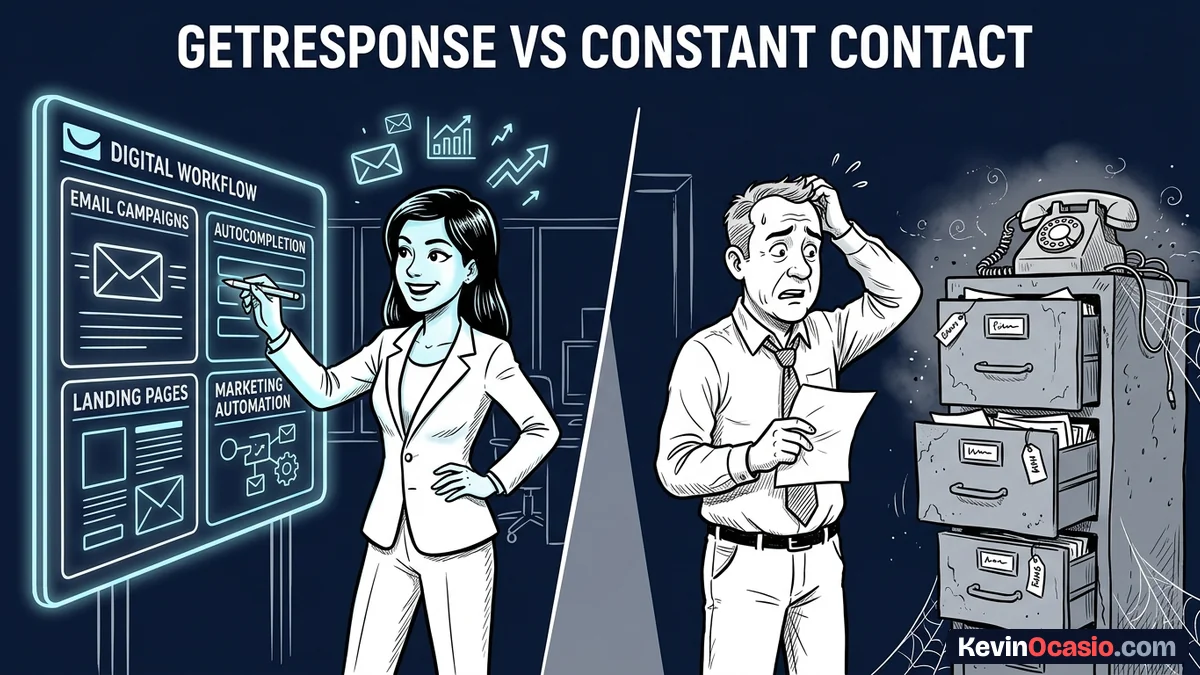
You want an email tool that turns new signups into buyers without huge bills. When you look at GetResponse vs Constant Contact, you’ll see two very different tools. One tool grew up with modern web sales, while the other feels stuck in 1995.
The Short Version
- GetResponse gives you modern sales funnels and welcome emails starting at $19/mo for 1,000 contacts.
- Constant Contact charges steep rates for simple newsletters while locking basic automated emails behind a $35/mo plan.
- Picking a modern email platform gives you better inbox delivery, visual sales funnels, and lower monthly bills.
Jump to Section
- GetResponse vs Constant Contact: Automation Workflows vs Basic Autoresponders
- Real Plan Limits and the Constant Contact Pricing Trap
- Deliverability, List Growth, and Solopreneur Mechanics
- Feature Comparison: Modern Sales Engine vs Legacy Newsletter Tool
- Pick the Tool That Builds Your List Without Draining Your Budget
- Frequently Asked Questions About GetResponse vs Constant Contact
GetResponse vs Constant Contact: Automation Workflows vs Basic Autoresponders
Setting up simple email flows is the best way to sell digital products without manually emailing every buyer. You need an email app that reacts to what readers do. It should tag new buyers. It’s built to send emails when someone clicks a link.
GetResponse gives you a visual drag-and-drop builder. Their entry Starter tier costs $19/mo and includes a custom workflow with unlimited autoresponder series. You can build welcome emails with ease. You’ll send emails the minute a new lead joins your list.
Constant Contact treats simple email series like a costly add-on. If you sign up for their base Lite option at $12 each month, you can’t set up automated series at all. The Lite plan only lets you send one-off email blasts. It also lets you schedule basic social posts.
To send basic follow-up emails in Constant Contact, you must upgrade to their Standard tier for $35/mo. Even on that higher plan, the builder feels stiff. It lacks the visual drag-and-drop tools found in modern apps. That’s why you get basic date triggers, but you miss out on real sales funnels.
Real Plan Limits and the Constant Contact Pricing Trap
Email tools make money by raising rates as your list grows. Looking past the low starting price shows a big pricing trap. It’s a trap that catches many new creators off guard.
GetResponse starts its plans at 1,000 contacts. On the Starter plan, you pay $19/mo with unlimited email sends each month. If you pay for a full year upfront, that rate drops to $15.58/mo. Your bill doesn’t go up until your list passes that 1,000-contact mark.
Constant Contact cuts its base list in half by capping you at 500 contacts. Their entry package sounds cheap. But it lacks automated series and holds only 500 names. Once your list hits 1,000 contacts, upgrading to the Standard plan for automated emails jumps your bill to $55/mo.
Paying $55/mo for a small list of 1,000 contacts hurts your cash flow. It eats up your profits before you make steady sales. If you want custom automations on Constant Contact, their Premium plan starts at $80/mo. That’s a pricing setup that punishes builders who are just starting out.
You can test your own subscriber count in the tool below to see the cost gap as your list grows.
GetResponse vs Constant Contact Cost Calculator
See how much cash you keep in your bank each year by comparing GetResponse and Constant Contact as your subscriber list grows.
Deliverability, List Growth, and Solopreneur Mechanics
Sending emails doesn’t help if your notes land in the spam folder. Landing in the main inbox takes a strong sender score. It also takes clean lists and solid mail servers.
Checking your email click-through and open rate benchmarks helps you catch inbox issues early. GetResponse keeps delivery rates high across its shared mail servers. It checks new signups for spam and offers built-in list cleaning tools.
Constant Contact started in 1995 as an email blast tool for local shops, clubs, and town groups. Many of those groups rarely clean their lists. That’s what hurts delivery scores across their shared network. If you sell digital goods online, you need a tool built for modern sales.
Understanding why simple software beats complex software helps you skip tools with messy menus. Constant Contact fills its screen with event tools and ads. GetResponse stays focused on opt-in forms and sales funnels.
Picking the best email marketing platforms for solopreneurs comes down to balancing low rates with reliable delivery. GetResponse gives you signup forms, popups, and landing pages in one place. You don’t need three extra apps to collect leads.
Feature Comparison: Modern Sales Engine vs Legacy Newsletter Tool
Here’s a direct side-by-side breakdown showing how both platforms compare across entry pricing, contact limits, automation features, and builder tools.
| Feature or Metric | GetResponse | Constant Contact |
|---|---|---|
| Starting Monthly Price | $19/mo (Starter Plan) | $12/mo (Lite Plan) |
| Base Contact Limit | 1,000 contacts | 500 contacts |
| Automated Email Sequences | Included on base tier | Requires $35/mo Standard plan |
| Cost at 1,000 Contacts | $19/mo | $55/mo (Standard Plan) |
| Monthly Email Sends | Unlimited | Capped at 24x contact tier |
| Visual Automation Canvas | Yes (Drag-and-drop workflows) | Basic multi-step logic only |
| Built-in Landing Pages | Included with lead forms | Basic landing pages |
The full GetResponse review shows how its landing page builder and autoresponder work together. They run well without extra plugins. Having your signup pages, email series, and list tools in one spot saves hours of work each week.
Constant Contact makes you glue extra tools together. Or it makes you pay high rates just to run a standard welcome series. For an online creator or solo shop owner, that extra friction slows down your work. It’s friction that also wastes your cash.
Pick the Tool That Builds Your List Without Draining Your Budget
If you run a local diner or a charity sending one news note a month, Constant Contact works fine. But for bloggers, creators, and solo builders selling online, it’s an old tool. It charges too much for too little.
GetResponse gives you twice the contacts on its base plan. You get uncapped email sends and visual funnels for a fraction of the price. You’ll get modern lead tools that help you turn casual readers into buyers from day one.
Start testing your funnels today with GetResponse to build a clean email asset that grows with your business.
Frequently Asked Questions About GetResponse vs Constant Contact
Is Constant Contact really from the 1990s?
Yes, Constant Contact started in 1995 under the name Roving Software. It was made in the early days of the web for local shops. Much of its layout still follows that old newsletter style.
Does GetResponse offer a free plan?
GetResponse offers a free 30-day trial with full access to core tools. Its old 500-contact free plan is gone for new signups. Paid plans start at $19/mo for up to 1,000 contacts.
Can I move my contacts from Constant Contact to GetResponse?
Yes, you can export your contact list as a CSV file from Constant Contact. You can import it into GetResponse in a few clicks. It’s an easy move that keeps your custom tags and contact details clean.
Which platform is cheaper for automated welcome emails?
GetResponse is much cheaper because it includes automated welcome emails on its $19/mo Starter plan for 1,000 contacts. Constant Contact locks email series behind its Standard plan. That plan costs $35/mo for only 500 contacts.
Does Constant Contact have sales funnels and webinar tools?
No, Constant Contact focuses on basic email broadcasts and event invites. GetResponse offers built-in sales funnels, webinar rooms, and digital product sales on its higher tiers.