You might think an online sales funnel needs six different upsell pages. It’s easy to assume you need countdown timers and complex logic trees to make sales. That’s dead wrong. Every extra step you add gives buyers another reason to leave.
The Short Version
- Extra steps kill sales by creating checkout friction and slow mobile load times.
- Strip your setup down to a clean path with a sales page straight to checkout.
- Protect your monthly profit by avoiding expensive software suites and multi-app stacks.
Jump to Section
- The Trap of the Multi-Step Funnel
- Why Simple Funnels Beat Complex Funnels on Mobile Screens
- Every Added Step Multiplies Technical Failure Points
- The Clean Two-Step Architecture That Actually Converts
- Protecting Your Cash Flow and Sanity as a Solo Operator
- Strip the Friction and Launch Your Simple Funnel
- Frequently Asked Questions About Simple Sales Funnels
The Trap of the Multi-Step Funnel
You’ve probably seen gurus teach the same playbook. They tell you to build a lead page and send traffic to a cheap offer. Then they tell you to push buyers through three upsells and two downsells before showing a receipt.
That math looks great on paper, but real buyers hate the experience. It makes people feel like they walked onto an aggressive used car lot.
Every time you ask someone to make another buying choice, mental fatigue sets in. A customer happily pulls out a card for a twenty-dollar guide, hits three upsell screens in a row, and closes the tab. You lose the backend sale and the main customer at the same time.
Why Simple Funnels Beat Complex Funnels on Mobile Screens
Most of your customers will hit your sales page on a phone today. Mobile shoppers don’t have the patience for slow redirects, popup windows, and tiny forms.
Someone taps your link from an email while standing in line. They want a fast page that loads right away. They want an easy way to pay and get on with their day. Complex funnels with multiple redirects crawl to a stop on cell networks.
Every second of delay hurts your sales. When you simplify your checkout forms, you remove the friction that makes buyers abandon their carts. Cutting extra fields and pages helps you close more sales.
A clean two-step setup wins on mobile screens because it cuts out the noise. You give the visitor one clear offer and an easy payment box with digital wallet support. They tap once, buy the item, and get their download link.
Every Added Step Multiplies Technical Failure Points
Multi-step funnels also create big tech headaches behind the scenes. Each extra step relies on tracking scripts and webhooks. Redirect cookies and payment tools must all stay in sync.
If a tracking pixel fails to fire, the redirect chain breaks. When a customer buys an add-on but their phone blocks cookies, your system charges their card without granting product access. Then you spend your morning dealing with angry emails.
Every extra connection between third-party platforms creates another place where customer data gets lost. You can easily lose an entire weekend troubleshooting broken webhook links when an API update changes how your tools communicate. My guide on why simple software beats complex software explains how fewer moving parts protect your business.
As a solo operator, you don’t have a tech team standing by to fix broken automations. When your funnel has only two pages, there’s almost nothing that can break.
The Clean Two-Step Architecture That Actually Converts
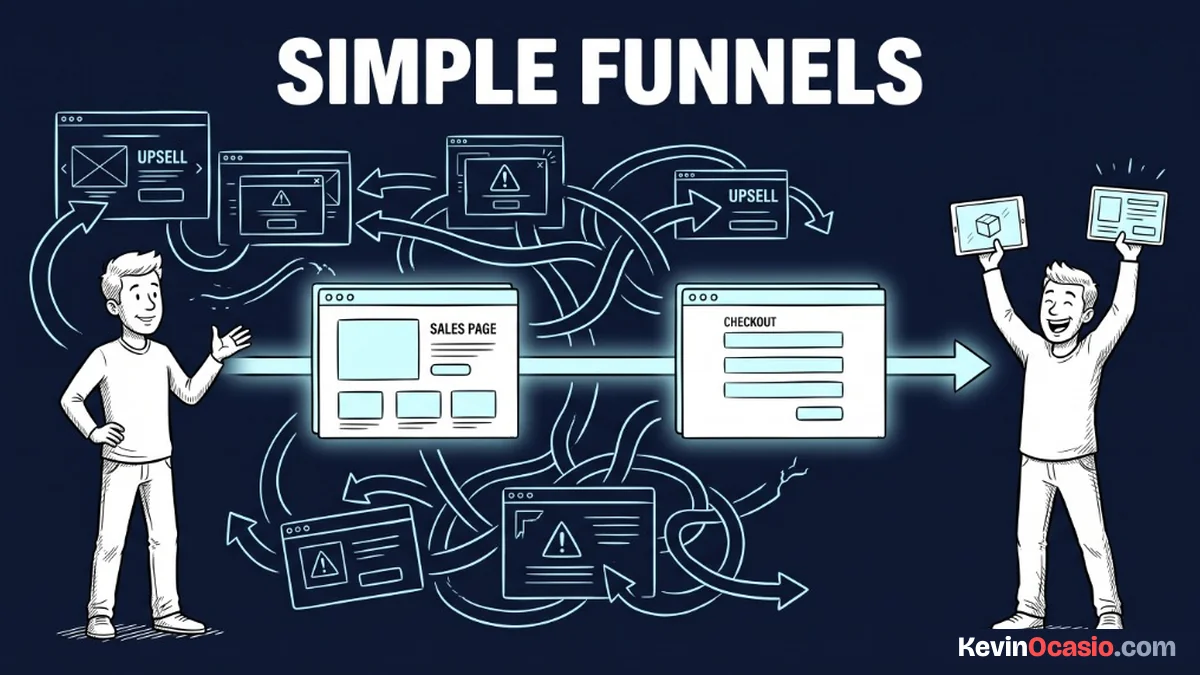
A great sales flow comes down to two basic screens. You need a sales page and a checkout page. Your sales page presents one clear offer and sends the reader to checkout.
You don’t need separate pages for upsells. If you want to raise your average order size, add a single order bump right on the checkout form. A buyer can check one box to add an audio track, a checklist, or a template pack without leaving the page.
Here is how a complex funnel compares to a clean two-step setup for a solo operator:
| Funnel Feature | Complex Multi-Step Funnel | Clean Two-Step Funnel |
|---|---|---|
| Page Count | 5 to 7 pages with popups | 2 clean pages |
| Mobile Checkout Time | 3 to 5 minutes across redirects | Under 60 seconds on one screen |
| Technical Failure Risk | High risk of broken webhooks | Near zero risk of failure |
| Build & Test Time | 15 to 25 hours of setup | Under 2 hours to launch |
| Monthly Software Cost | $97 to $297 per month | $0 to $27 per month |
You can run this two-step flow using a lightweight dedicated sales funnel builder. It handles your pages, email list, and checkout in one place. The Systeme.io breakdown shows how to set this up without high monthly fees.
Protecting Your Cash Flow and Sanity as a Solo Operator
The biggest cost of a complex funnel isn’t the software bill, though paying hundreds of dollars each month hurts. The real cost is your time and mental energy.
When you spend weeks building complex logic trees, you lose time. You aren’t talking to buyers or creating new products. You get trapped in setup mode instead of making sales.
My guide on building a minimalist marketing setup covers how cutting out extra tools frees up hours of your week. A simple two-step funnel gives you clear numbers. You only need to watch two stats: page views and sales.
If your sales page gets traffic but nobody buys, your copy or offer needs work. When your funnel has seven steps, finding where people drop off takes days of analytics work.
Strip the Friction and Launch Your Simple Funnel
Take an honest look at your current sales flow today. Open your checkout on your phone using cell data. Time how long it takes to buy your own product.
Cutting out extra upsell pages stops buyers from second-guessing their purchase. Put your best add-on product on the checkout page as an order bump where a single checkbox upgrades the purchase without interrupting the customer.
Keep your checkout form down to the bare basics: name, email address, and card info. When you remove extra steps, you make it easy for buyers to pay you. That simplicity is what keeps your business growing.
Frequently Asked Questions About Simple Sales Funnels
What is the ideal number of steps in a simple sales funnel?
A simple sales funnel works best with two steps: a sales page that explains the offer and an order form where the buyer pays. You can also place the checkout form right on the sales page below the copy.
Do order bumps make more money than multi-page upsells?
Order bumps often convert better because they don’t stop the checkout flow. A customer checks one box on the payment screen to add an extra item. They don’t have to click through extra pages.
How does a simple funnel improve mobile sales?
Simple funnels cut out extra redirects that slow down phone screens. With fewer fields to fill out on a mobile device, buyers finish their orders fast.
Can a two-step funnel generate as much revenue as a complex one?
Yes, simple funnels often make more money because fewer people leave the cart. You make up for lost upsells by turning more visitors into buyers.
What software do I need to build a simple sales funnel?
You only need a basic page builder, an email tool, and a payment processor. All-in-one tools handle all three jobs in one place, or you can use WordPress with a lightweight checkout plugin.
When does a complex multi-step funnel make sense?
Complex funnels can make sense for big corporate teams. They have staff to watch every step. For solo builders selling digital items, simple funnels win on speed and ease.
How do I track conversions on a simple sales funnel?
Tracking a two-step funnel is easy. You only watch two numbers: visitors on the sales page and orders on the thank-you page. Dividing total orders by visitors gives you your exact rate right away.
Will removing upsell pages hurt my average order value?
Not if you add an order bump to the checkout form. A simple bump offer priced between $17 and $47 lets buyers upgrade their order right at checkout. It boosts your profit without adding extra pages.