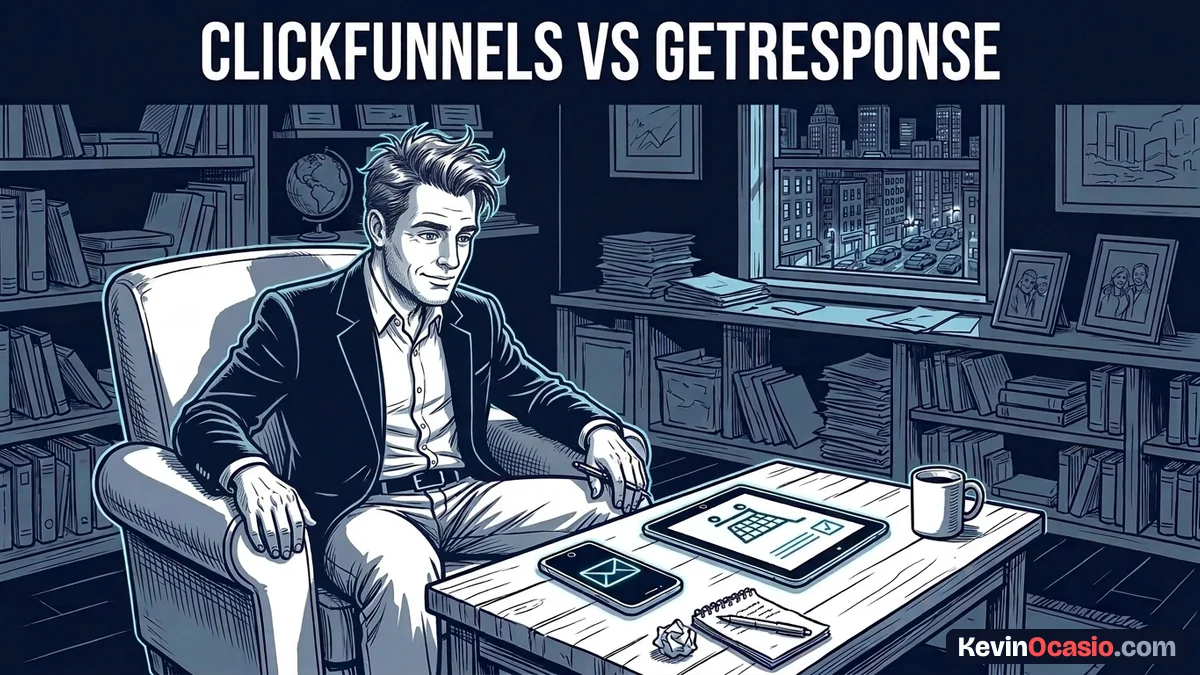
ClickFunnels costs $97 a month because it starts at checkout, while GetResponse runs $19 a month because it starts in the inbox. Pick the wrong one first and you pay for tools you don’t use or lose sales at the cart.
The Short Version
- Checkout tools vs inbox power put ClickFunnels ahead on order bumps and one-click upsells while GetResponse leads on list growth and emails.
- Tier limits hit quickly because GetResponse Starter ($19/mo) caps you at one email flow, Marketer ($59/mo) adds sales funnels, and Creator ($69/mo) adds webinars.
- The 10,000-contact crossover flips pricing since GetResponse bills by list size from 1,000 contacts while ClickFunnels Launch includes 10,000 contacts at $97 a month.
Jump to Section
- ClickFunnels vs GetResponse: Where Each Tool Starts
- Order Bumps and One-Click Upsells vs Email Follow-Up Paths
- List Growth Math: 1,000-Contact Tiers vs a Month
- Webinars, Courses, and Selling Under One Login
- Pick the Tool That Fits How You Sell Today
- Frequently Asked Questions About ClickFunnels vs GetResponse
ClickFunnels vs GetResponse: Where Each Tool Starts
When you put ClickFunnels and GetResponse side by side, you pick which half of your business needs help first. Both apps build landing pages and send timed emails. Still, they solve two very different jobs on day one.
ClickFunnels starts at the cart. Launch runs $97 a month, or $81 paid yearly ($970). You get 1 workspace, 5 domains, 3 courses, uncapped funnels, and 10,000 contacts at 0% fees. My full ClickFunnels guide shows how each tier stacks up.
GetResponse starts as an email tool and adds funnel pages on higher tiers. Starter runs $19 a month ($15.58 a month on a yearly plan at $187) for 1,000 contacts. That base tier gives you unlimited email sends, signup forms, and a page builder. It makes sense when you need leads before you launch a product.
Trying to force either app to do the other’s job gets hard fast. If you have a finished product ready to sell, try ClickFunnels for 14 days and build your cart first. If you still need readers before you have an offer, paying $97 a month for empty pages drains cash you shouldn’t spend.
Order Bumps and One-Click Upsells vs Email Follow-Up Paths
At checkout, ClickFunnels pulls ahead because it makes it easy for buyers to spend more while their card is out. On the order form, you can stack two or more order bumps so buyers add a checklist or bonus pack with one click. Right after the card clears, the next page pitches a one-click upsell or lower-priced downsell without asking for a card number again.
GetResponse works harder after someone leaves your page. Instead of post-sale upsell trees, you build an automated email lead funnel that greets new signups, tracks clicks, and pitches your offer over days. Sending a welcome email series gives fresh leads more chances to trust you rather than hoping strangers buy on visit one.
Tier caps inside GetResponse decide how far you can push those paths, though. Starter ($19/mo) caps you at one custom flow, with zero sales funnels, order pages, or missed-cart emails. You have to step up to the $59 Marketer plan ($48.38 a month paid yearly at $580) to unlock unlimited email paths, promo codes, and built-in sales funnels.
ClickFunnels 2.0 also built in its own visual email flow tool, so you don’t need a second email app now. You can tag buyers, trigger follow-up drips, and send blasts from one login. Even so, it shines brightest at the cart, while GetResponse gives you cleaner list tags when you warm up leads over weeks.
List Growth Math: 1,000-Contact Tiers vs $97 a Month
Base prices hide half the truth because each tool counts contacts in a different way. GetResponse sets its $19 Starter, $59 Marketer, and $69 Creator rates at 1,000 contacts, and your bill rises as your list adds names. ClickFunnels Launch gives you 10,000 contacts for $97 a month, then steps up to Scale ($197/mo for 75,000 contacts) and Optimize ($297/mo for 150,000 contacts).
Once your list passes a few thousand readers, that gap shrinks fast. On GetResponse Starter alone, hitting 10,000 contacts lifts your bill to $79 a month with zero sales funnels. Moving to Marketer or Creator at that 10k mark costs more each month than ClickFunnels Launch. See my full GetResponse breakdown to check how those tier jumps play out.
Here’s how the core tools and starting caps stack up side by side.
| Business Need | ClickFunnels ($97/mo Launch) | GetResponse ($19 to $69/mo Base) |
|---|---|---|
| Starting Monthly Price | $97/mo ($81/mo billed yearly) | $19/mo Starter ($15.58/mo yearly) |
| Base Contact Limit | 10,000 contacts included | 1,000 contacts (scales by list size) |
| Order Bumps & 1-Click Upsells | Multiple bumps and 1-click upsell/downsell flows | No order bumps; up to 3 one-click upsells on Marketer ($59/mo) |
| Email Workflows & Sends | Visual workflows, broadcasts, and tagging built in | 1 flow on Starter; unlimited flows on Marketer ($59/mo) |
| Webinars & Courses | 3 courses on Launch; no native video room | 100-seat webinars and courses on Creator ($69/mo) |
| Missed Cart Recovery | Built into checkout paths | Included on Marketer ($59/mo) and Creator ($69/mo) |
| Platform Sale Fee | 0% (standard card fees apply) | 0% (standard card fees apply) |
While you’re under 1,000 contacts and don’t need upsell trees yet, keeping your bills low is the smart play. You can start a 30-day GetResponse trial to test the email tool and pages while your list is small. Just clean out cold leads often so you don’t pay for folks who never open your mail.
Webinars, Courses, and Selling Under One Login
Live events and online courses show one more sharp split between these apps. On ClickFunnels Launch ($97 a month), you get three courses and unlimited pages at the base price, so you can sell and teach from one spot. ClickFunnels doesn’t host live video rooms, though, so live calls still need an outside link.
GetResponse packs courses and live webinars into its $69 Creator plan ($56.58 a month paid yearly at $679 for 1,000 contacts). That tier gives you a live webinar room for 100 guests, course hosting for 500 students, and full email tools without paying for Zoom. For coaches running live Q&A calls under 100 seats, keeping signups, alerts, and video under one bill stays simple.
Pick the Tool That Fits How You Sell Today
ClickFunnels wins for checkout carts and upsells. Go with ClickFunnels when you already have a product, coaching offer, or paid ads. It gives you order bumps, one-click upsells, and 10,000 contacts for $97 a month.
GetResponse wins for email lists and webinars. Choose GetResponse when your main goal is growing a list under 1,000 contacts. You get unlimited emails on the $19 Starter plan, or 100-seat webinars on the $69 Creator tier.
Test the flow that fits your next thirty days before buying a yearly plan. Build your checkout path during ClickFunnels’ 14-day trial if your offer is ready to sell. Or use GetResponse’s 30-day trial to get your signup form and welcome emails live today.
Frequently Asked Questions About ClickFunnels vs GetResponse
Can I run one-click upsells in GetResponse like ClickFunnels?
GetResponse Marketer ($59/mo) lets you add up to three one-click upsell pages after checkout, though it doesn’t include order bumps or downsell branches. If your sales rely on order bumps and one-click upsells at checkout, ClickFunnels is built for that job.
Does GetResponse still have a free plan?
No, GetResponse dropped its old 500-contact free plan for new signups. You get a 30-day free trial to test the app, and paid plans start at $19 a month for up to 1,000 contacts.
Do I need both ClickFunnels and GetResponse at the same time?
You don’t, since both apps now include landing pages and visual email paths. Paying for both leaves you with two monthly bills unless you have a huge list in GetResponse and only want ClickFunnels for carts.
Which plan on GetResponse includes webinars and courses?
Webinars and courses unlock on the GetResponse Creator plan at $69 a month ($56.58 a month paid yearly) for 1,000 contacts. Starter ($19/mo) and Marketer ($59/mo) don’t include the webinar room or course host.
Is ClickFunnels worth $97 a month for a brand-new site?
Only if you already have a product ready to sell and traffic hitting your page. If you haven’t built a list or made sales yet, the $19 GetResponse Starter plan keeps your bills low while you grow.