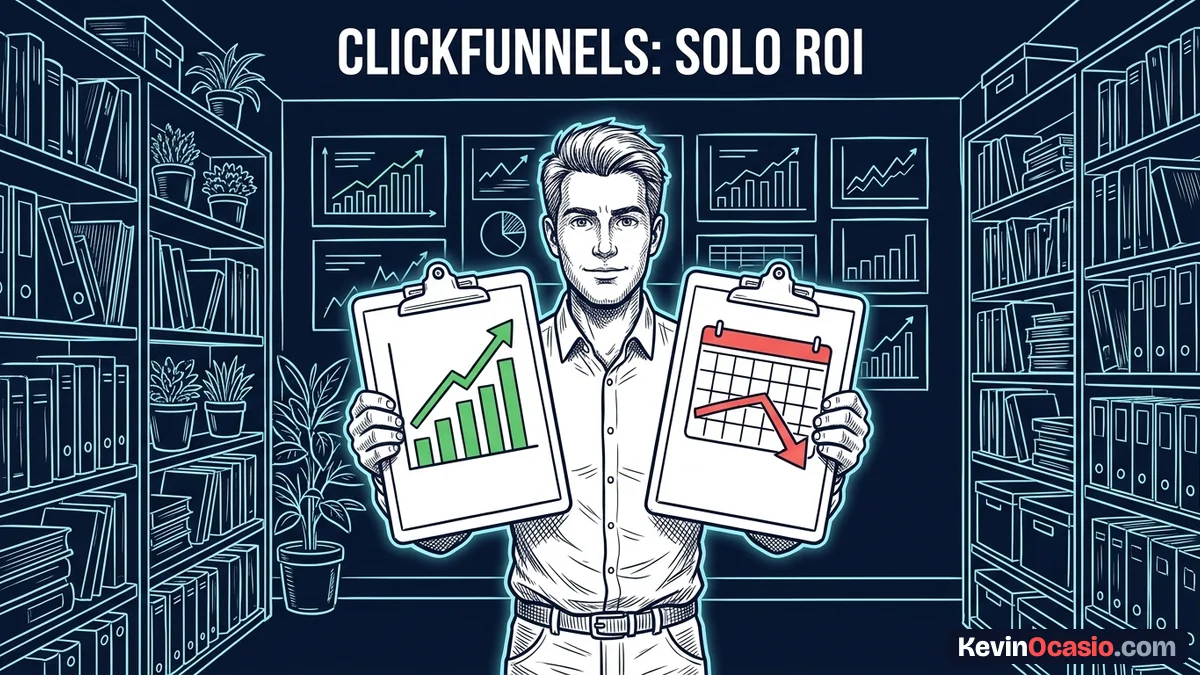
It’s easy to hand $97 to ClickFunnels before you make a single dollar online. You sign up for a free trial, pick a flashy template, and suddenly find yourself staring at a recurring charge that burns a hole in your budget.
The Short Version
- Validate your digital product before paying for monthly sales funnel software.
- Two sales per month with an order bump cover the entire $97 Launch plan fee.
- Skip expensive funnel builders until you have real traffic and an active buyer list.
Jump to Section
- The Dilemma: Smart Sales Engine or Monthly Cost Trap?
- The 2-Sale Break-Even Math on a Low-Ticket Funnel
- When Is ClickFunnels Worth It vs When It’s a Waste of Money
- How Order Bumps and 1-Click Upsells Shift Your Unit Economics
- Protect Your Cash Flow Before You Commit to a Month
- Frequently Asked Questions About Whether ClickFunnels Is Worth It
The $97 Dilemma: Smart Sales Engine or Monthly Cost Trap?
Spending $97 each month feels small when you watch hype videos about giant product launches. But when you work alone, software bills add up fast. Over a full year, that single tool takes $1,164 out of your bank account.
Don’t treat software like a magic cure. Buying a shiny page builder won’t make you write sales pages or launch products. In real life, an empty page on a quiet web domain makes zero dollars. It just dings your debit card every thirty days.
You only get good value from a tool when it solves an active sales problem. When you look at ClickFunnels pricing, the entry Launch plan gives you twenty funnels and space for ten thousand contacts. Those caps are big for a solo creator, but paying for room you never touch is just throwing cash away.
If you don’t have an active product ready to sell, that monthly fee is dead weight. You rush your offer to beat the fourteen-day trial clock. You make sloppy mistakes, and you carry a heavy software bill with zero sales to show for it.
The 2-Sale Break-Even Math on a Low-Ticket Funnel
Let’s look at the basic unit math of a simple digital product funnel. Say you sell a short digital guide for $50. At checkout, you add an order bump for $27 that offers a set of checklist sheets or audio files.
When a buyer checks both boxes, the total order is $77. Stripe takes a cut to process the payment. Standard card processing costs 2.9% plus thirty cents per sale. That takes $2.53 off your $77 order, leaving you with $74.47 in clean cash deposited in your bank.
If you get just one buyer in thirty days, that $74.47 leaves you $22.53 short of the $97 software bill. But the moment you make a second sale, your net payout hits $148.94. You pay off the $97 fee in full and keep $51.94 in pure profit.
You pay higher customer acquisition costs every year as buyer traffic gets more expensive. When ad costs jump, you can’t rely on lone products without bumps to stay in the black. Lifting your order value from $50 to $77 on the exact same checkout page is what makes the tool pay for itself.
When Is ClickFunnels Worth It vs When It’s a Waste of Money
Deciding to pay for this platform comes down to where you stand today with your offer, your traffic, and your audience.
Here’s a clear look at different situations to show when the tool makes sense and when it burns your cash.
| Business Situation | Monthly Software Bill | Sales Needed to Break Even | The Real Verdict |
|---|---|---|---|
| Beginner with No Offer | $97 per month | Infinity (Zero Sales) | Pure waste of cash ($1,164 yearly burn) |
| Solo Creator with $50 Guide | $97 per month | 2 sales with $27 bump ($74.47 net each) | Profitable with $51.94 in net monthly profit |
| Blogger with Organic Traffic | $97 per month | 3 to 4 standalone sales ($48.25 net each) | Borderline (start on a free checkout cart first) |
| Paid Traffic Ad Operator | $97 per month | 1 core sale plus 1 upsell | Great fit (maximizes average order value) |
Looking at this table makes the math plain. If you have no offer and no web traffic, you’re paying $97 a month for an empty digital locker. You’re much better off seeing why simple funnels beat complex funnels and keeping your setup tiny until you test your idea.
Once you have buyers clicking from search or your email list, the picture flips. You only need two buyers a month to turn the tool into a free asset.
How Order Bumps and 1-Click Upsells Shift Your Unit Economics
The main reason to pick a sales funnel tool over a basic website cart is how easy it makes upselling. Basic carts make buyers type in credit card numbers twice or click through extra web pages, which kills sales fast.
ClickFunnels works well because its checkout pages feature simple checkbox bumps and one-click upsell buttons. When a buyer enters their card on your main offer, they can take an add-on item with one tap. The system bills the card on file without asking for payment details again.
Testing this setup on their 14-day free trial shows how fast you can build clean checkout flows. You don’t need custom code or tricky webhooks. Check out the ClickFunnels review to see how the checkout editor sets up bumps and add-on offers step by step.
That speed matters when you run a solo shop. If a simple checkout bump adds an extra $100 a week from people who were already buying your main guide, the tool pays its own way with cash to spare.
Protect Your Cash Flow Before You Commit to $97 a Month
Hold off on signing up for paid sales tools until your core guide or course is ready to send. Spending your days tweaking page colors before you write a single word of your guide is just a shiny-object trap.
Draft your sales copy in a simple document and set up your download files first. If you don’t have a crowd yet, grow your list with simple opt-in pages before paying for high-tier software. Keeping your monthly software bills close to zero gives you time to find your first buyers without stress.
Once people line up to buy your offer, grab the tool and turn on your order bumps. That keeps your money safe and lets real buyer sales pay your software bills from day one.
Frequently Asked Questions About Whether ClickFunnels Is Worth It
Is ClickFunnels worth it if I don’t have an email list?
No, it’s not a good buy if you have zero audience. Without web visitors seeing your checkout page, you pay $97 each month with no sales. Build your email list on free tools first, then upgrade once you have buyers ready.
How many sales do I need each month to break even on ClickFunnels?
If you sell a $50 guide with a $27 order bump, you need two sales a month. Two orders pay you $148.94 after Stripe fees, which covers the $97 Launch fee and leaves $51.94 in profit.
Can a solo creator run a business on the ClickFunnels Launch plan?
Yes, the Launch plan holds twenty funnels and ten thousand email contacts. That gives a solopreneur plenty of room to sell digital goods and courses without hitting tier limits.
Is the 14-day ClickFunnels free trial enough time to build a funnel?
Fourteen days is plenty of time if your sales copy and product are ready before you sign up. If you start from zero during the trial, you’ll likely get billed before you launch.
Does ClickFunnels take a percentage of my product sales?
ClickFunnels takes zero percent in platform fees on all paid tiers. You only pay card processing fees to Stripe or PayPal, which runs 2.9% plus thirty cents per sale.
Should I choose ClickFunnels or self-hosted WordPress for my sales funnels?
Pick WordPress if you want full control and you like managing plugins to save money. Pick ClickFunnels if you want fast checkout bumps and zero hosting maintenance.
What happens if I cancel my ClickFunnels account?
Your pages go offline at the end of your billing cycle. You can export your buyer lists and contacts at any time, but your live funnels stop working.
Can I use my own custom domain on ClickFunnels?
Yes, the $97 Launch plan connects one custom domain or subdomain. You can host funnels on your own brand name with free SSL security included.